How Much Does a Kitchen Remodel Actually Cost? A Kansas City Contractor Breaks Down Real Numbers
How Much Does a Kitchen Remodel Actually Cost? A Kansas City Contractor Breaks Down Real Numbers
If you’ve searched this question, you’ve probably already found a dozen articles giving you a vague national range and calling it a day. I’m not going to do that to you.
I’m a licensed general contractor specializing in home remodeling here in the Kansas City metro — including Overland Park, Lenexa, Prairie Village, Leawood, Shawnee, Olathe, and the rest of Johnson County. I’ve completed hundreds of kitchen remodels, including projects featured on TV. So instead of guessing, let’s talk about what kitchens actually cost right now, in this market, based on real projects I’ve bid, built, and walked clients through.
The Three Real Tiers of Kitchen Remodel Pricing
Kitchen remodels in the Kansas City area generally fall into three tiers:
Bare-bones refresh: $30,000–$40,000. This is a facelift, not a gut job — new cabinet fronts or a paint-grade cabinet swap, updated countertops, refreshed backsplash, maybe new flooring. No moved walls, no relocated plumbing.
Mid-range remodel: $50,000–$80,000. This is where most homeowners actually land. Real cabinet upgrades, better countertops, updated electrical, and a layout that’s improved but not fully reimagined. Where you fall in that range depends heavily on the size of the kitchen.
Full custom gut renovation: $90,000+. Walls come out, layouts change completely, and you’re choosing high-end cabinetry, premium stone, and luxury appliances.
Real Case Study: A $110,000 Full Gut Renovation in Overland Park
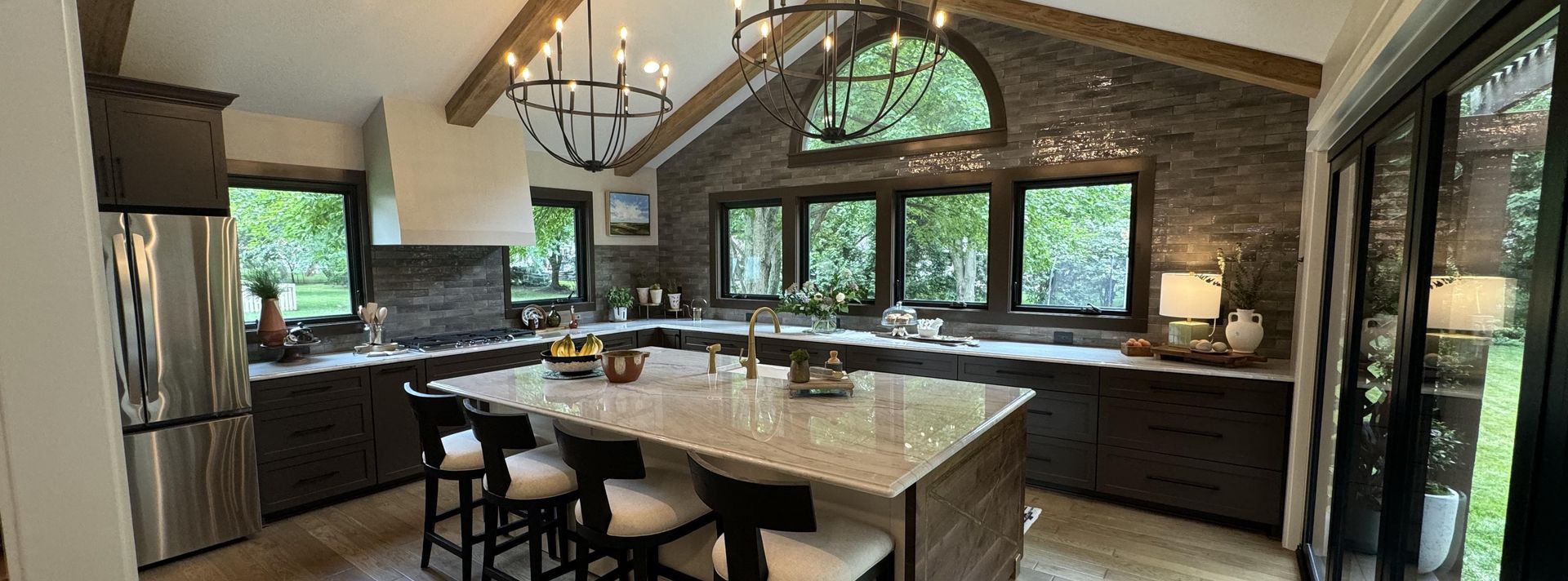
To make this concrete, let’s look at an actual project. In South Overland Park, we tackled a full gut kitchen renovation for a client ready to start fresh. We tore out the old red oak cabinets and completely reimagined the layout for a more modern feel.
The final kitchen included a custom walnut island, a matching walnut hutch and hood, a 36” range, and a 42” panel-ready Sub-Zero refrigerator. The upper cabinets featured glass fronts with integrated LED lighting. The total landed right around $110,000.
Here’s what’s interesting: the walnut cabinetry wasn’t actually the single biggest line item. A huge chunk of the budget went into a full-height backsplash using Taj Mahal quartzite — a natural stone prized for its soft, creamy background and subtle gold veining, and genuinely one of the most beautiful upgrades you can put in a kitchen. On top of that, the client added a Bose surround sound system, a custom LED lighting system for the upper and under-cabinet areas, and hidden outlets tucked under the cabinets. Those “invisible” details — lighting, sound, outlet placement — add up fast, and they’re rarely on a homeowner’s radar when they’re picturing their budget.
A Smarter Path to a Beautiful Kitchen on a Real Budget
Not every project needs to be six figures, and I want to share an example that proves it.
I recently wrote an estimate for a client on a specific budget. They wanted to use our 24-month same-as-cash financing and needed a number they’d feel comfortable paying off in that window. They’d already gotten two other estimates — $88,000 and $100,000. Both of those companies quoted full custom cabinetry, which blew straight past what the client had actually told them they wanted to spend.
We listened instead. By using a mixture of semi-custom cabinetry — real hardwood boxes with soft-close features and a pre-finished painted face — paired with an upper-end countertop and a beautiful backsplash, we brought the whole project in at $65,000. Same gorgeous end result the client was picturing, significantly less than the competing bids, because we built the design around their actual number instead of upselling past it.
Where to Splurge, and Where to Save
After hundreds of kitchens, I’ve got strong opinions on this.
Save here: You don’t need the priciest natural stone to get a stunning countertop. There are excellent quartz options that give you real durability and a designer look without paying quartzite or marble prices. And a lot of “high-end feel” comes from design decisions, not raw spending
Splurge here, selectively: Pick one hero feature and go all-in on it. I have a client right now mixing a nice pre-finished semi-custom line for the bulk of her cabinets, then splurging on a custom island made of white oak. She’s getting a true designer kitchen with real cost savings, because the semi-custom cabinets are still solid hardwood boxes with soft-close hardware — a durable, long-serviceable product — while the one splurge piece does the visual heavy lifting.
What Actually Makes Up the Budget
If you’re trying to guess where your money will go, here’s the general breakdown I see:
- Cabinets: 40–60% of your total budget, depending on the line you choose
- Countertops: 10–25%
- Electrical, appliances, and backsplash make up most of the rest
- Structural changes — moving or removing walls — can eat a huge portion of the budget on their own, if they’re part of your project
The Biggest Mistake Homeowners Make
It’s not hidden fees. A well-written scope from a reputable contractor should catch most of those before work starts.
The real issue is expectations. Most people only check the price of a kitchen remodel once every few years, so they’re anchored to a number that’s now out of date. A kitchen that cost $20,000 a couple of years ago might realistically cost $45,000 for the same scope today, simply because construction and material costs have climbed. Getting your expectations aligned with today’s market — before you fall in love with a design — makes the whole process smoother.
Closely related: design has to match budget from day one. If your material selections aren’t locked in early, you end up relying on rough, speculative allowances instead of real numbers, and that’s exactly how projects drift over budget. The more you can nail down finishes and selections up front, the more accurate — and dependable — your number will be.
Timeline: From First Call to Finished Kitchen
- Estimate turnaround: 7 business days or less from our initial walkthrough to you having a number in hand
- Pre-construction planning: typically a few weeks to a few months, used for finalizing material selections, pulling permits, and finishing cabinet layouts
- Construction: 4–8 weeks on average, once work actually begins
That planning window matters more than people think — it’s what lets you walk into construction with real allowances instead of guesses.
Your First Step
If you’re in the Kansas City area — Overland Park, Lenexa, Prairie Village, Leawood, Shawnee, Olathe, or anywhere in Johnson County — the first step is establishing your budget.
If you don’t have one yet, sit down with a contractor for a walkthrough estimate. Talk through your wants, your needs, and get a general price built around real allowances. From there, you’ll know whether you want to push toward higher-end finishes, or whether you need help reining things in.
The most useful thing you can bring to that conversation is a priority list. Maybe a large island is non-negotiable for you. Maybe it’s a panel-ready Sub-Zero. Knowing what matters most lets us build a plan — and a budget — around your priorities, and find a way to get you an awesome kitchen at the number that works for you, whether that’s financing or paying outright.